
Whether you're a player joining your first padel tournament or an organizer setting one up, understanding the rules is essential. Padel tournaments come in several formats, each with its own rotation, scoring, and tiebreaker rules.
This guide covers the three most common padel tournament formats and the rules that govern them.
The Main Tournament Formats
1. Americano
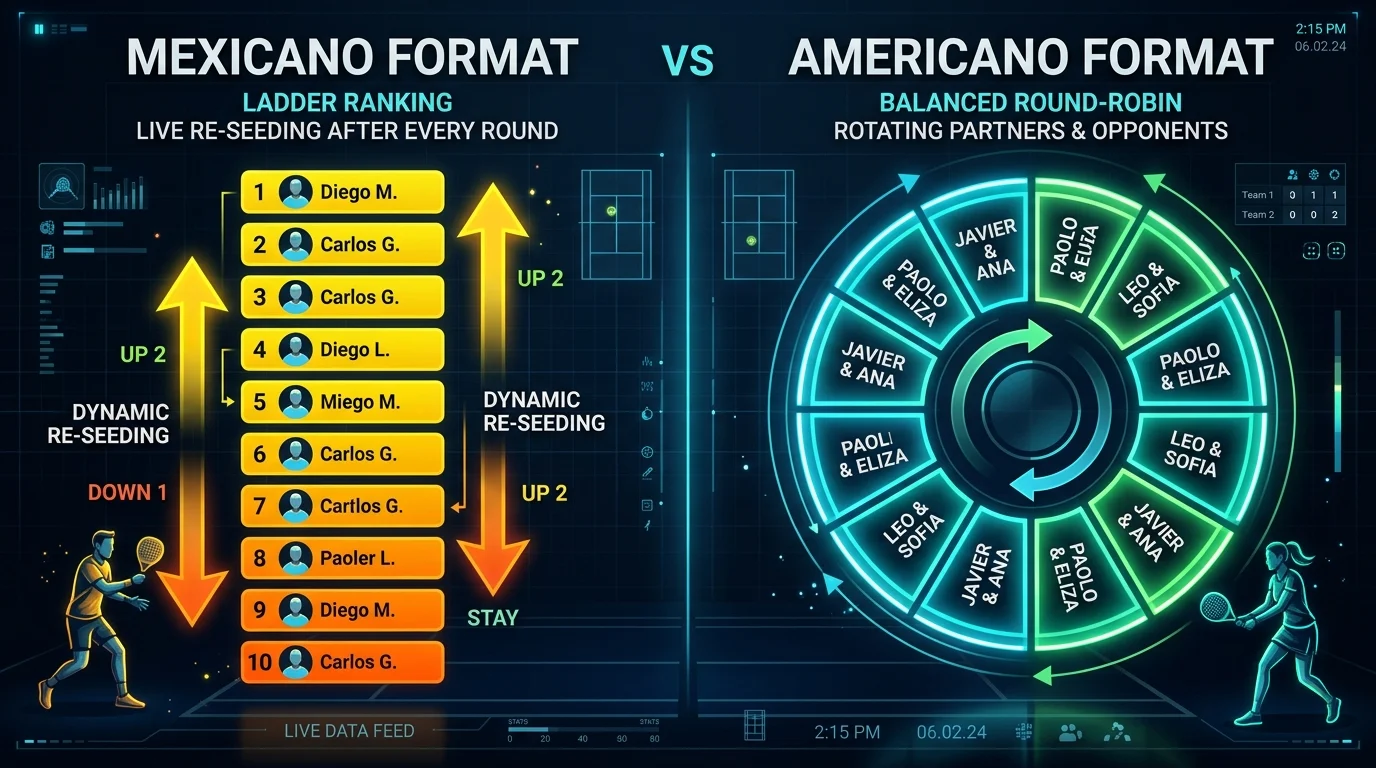
The Americano format is a round-robin where every player partners with every other player exactly once. Players accumulate individual points across all rounds, and the player with the most total points wins. For step-by-step setup and round calculations, read our complete guide on how to organize an Americano tournament.
Key rules:
- Partners rotate every round
- Number of rounds = number of players minus 1
- Individual scores accumulate (you keep the points your team earned)
- All matches in a round are played simultaneously
2. Mexicano
Mexicano is a dynamic pairing format where matchups are determined by the current standings after each round. The top two players in the leaderboard partner against the 3rd and 4th players, and so on down the rankings. See our detailed comparison of Mexicano vs Americano to see how they differ in play dynamic.
Key rules:
- First round pairings are random or seeded
- Subsequent pairings are based on standings (1st + 2nd vs 3rd + 4th, etc.)
- Ensures competitive balance — strong players face each other more often
- Same scoring as Americano (individual point accumulation)
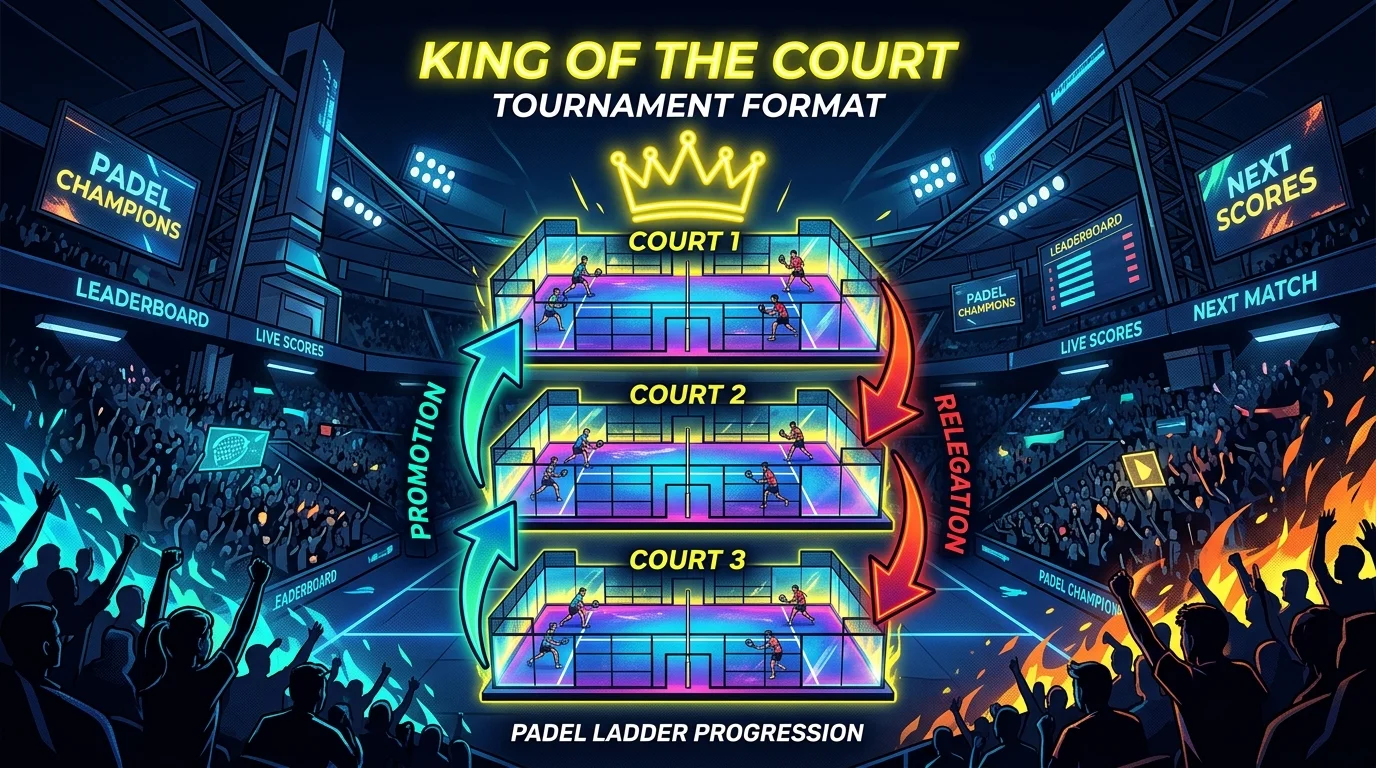
3. King of the Court (Ladder)
If you want a fast-paced continuous game where winning teams climb to the top court and losing teams slide down, explore the King of the Court format.
4. Bracket / Knockout
Traditional elimination bracket where fixed teams compete. Losing teams are eliminated, and winners advance. Can use single or double elimination.
Key rules:
- Teams are fixed throughout the tournament
- Matches are best-of-one or best-of-three sets
- Losers exit (single elimination) or go to loser bracket (double elimination)
- Seeding determines initial matchups
Scoring Systems
Standard Padel Scoring (for bracket tournaments)
Padel uses the same scoring as tennis: 15-30-40-game, with deuce at 40-40. A set is won at 6 games with a 2-game lead, or 7-6 with a tiebreak. Matches are typically best of 3 sets.
Points-Based Scoring (for Americano/Mexicano)
In social tournament formats, a simplified scoring system is common:
- Play to a fixed number of points (e.g., 32 points per match)
- Each rally won = 1 point
- Both teams' individual players receive the points their team scored
- Example: If Team A wins 21-11, both players on Team A get 21 individual points
Time-Based Matches
Some tournaments use timed matches (10-20 minutes). When time expires, the team with more points wins. This keeps the tournament on schedule and ensures predictable round durations.
Tiebreaker Rules
When two or more players end with the same total score, common tiebreakers include:
- Head-to-head result — Did one player beat the other when they were on opposing teams?
- Point differential — The difference between points scored and points conceded across all rounds.
- Number of wins — Total rounds where the player's team won.
- Playoff match — A single deciding match between tied players.
Court Rules & Etiquette
Before the Match
- Warm up for 5 minutes maximum before the match starts
- Decide which team serves first (coin toss or mutual agreement)
- Make sure all players know the scoring format being used
During the Match
- Ball in/out calls: Players call lines on their own side. Be honest and generous — if in doubt, the ball is in.
- Service rules: Underhand serve, ball must bounce once before hitting. Serve diagonally to the opponent's service box.
- Wall play: The ball can hit any wall on your side after bouncing once. It can hit the back glass directly after bouncing.
- Let serves: If the serve hits the net and lands in the correct box, it's a let — serve again.
Between Rounds (Americano/Mexicano)
- Transition quickly — 5 minutes maximum between rounds
- Report your scores to the organizer or enter them in the tournament app
- Check the schedule for your next court assignment
- Stay hydrated and ready for the next match
Tips for Tournament Organizers
- Choose the right format — Americano for social events (everyone plays with everyone), Mexicano for competitive balance, Bracket for serious competition.
- Use tournament management software — Apps like Banana Padel automate rotation, scoring, and live leaderboards, eliminating manual errors.
- Set clear time limits — Especially for Americano/Mexicano, timed matches keep the event on schedule.
- Communicate rules beforehand — Send the format, scoring system, and schedule to all players before the event.
- Have a backup plan — Rain, no-shows, or technical issues happen. Know how to handle odd numbers or reduced courts.
Using Digital Tools for Tournament Management
Modern padel tournament applications like Banana Padel handle the complexity of tournament management automatically. Instead of manually creating rotation schedules, tracking scores on paper, and calculating standings by hand, a tournament app provides:
- Automatic player rotation — algorithms generate fair pairings
- Real-time scoring — enter scores from any device
- Live leaderboards — display on TV or mobile
- Push notifications — alert players when it's their turn
- Elo ratings — track player skill development over time
These tools save organizers hours of preparation and eliminate the most common source of tournament problems: manual errors in rotation and scoring.
Frequently Asked Questions
What are the official scoring rules in padel tournaments?
Official competitive padel matches use traditional tennis scoring (15, 30, 40, Game) with best-of-3 sets. In social formats like Americano and Mexicano, matches use cumulative point scoring to 24 or 32 total points where every won point counts toward individual standings.
What is the Golden Point (Punto de Oro) rule?
The Golden Point rule is used when a game reaches 40-40 (Deuce). Instead of requiring an advantage of two points, a single deciding point is played. The receiving team chooses which side will receive the serve.
Can a padel ball bounce off the fence during a serve?
No. On a serve, after bouncing in the receiver's service box, the ball may hit the glass wall, but if it hits the metallic wire mesh fence before a second bounce, it is called a fault.
What happens during a tiebreak in knockout padel tournaments?
A standard 7-point tiebreak is played at 6-6 in games. Players change sides every 6 points, and the first pair to reach 7 points with a 2-point margin wins the set.
How does the Elo rating system work for padel players?
Elo rating algorithms calculate expected match outcomes based on the skill ratings of both pairs. Winning against higher-rated opponents yields greater rating gains, and point differentials in games fine-tune the rating adjustment.

Padel Club Manager
Certified Padel Referee, managed 50+ local and international tournaments
View all guides by Anna KovalevaTry Banana Padel for Free
Create and manage Americano & Mexicano tournaments with automatic rotation, live scoreboards, and Elo ratings. No subscription required.