King of the Court (also known as King's Court or Queen of the Court) is a highly energetic, fast-paced padel tournament format. It brings a unique competitive ladder dynamic to social play: players win to climb to the "King's Court" or lose and risk sliding down to the bottom court.
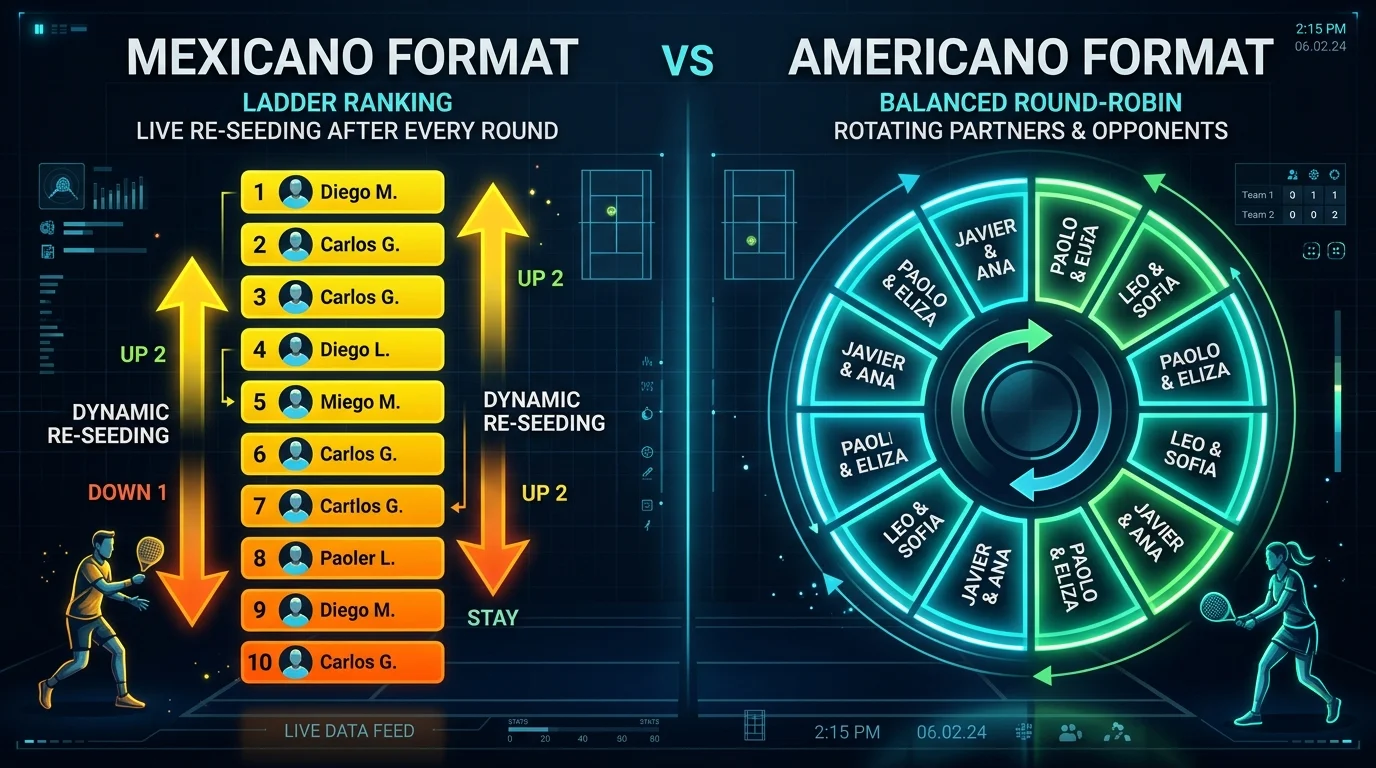
Before diving into tournament setup, make sure you're familiar with general padel rules and etiquette in our complete guide to padel tournament rules. In this guide, we'll explain how King of the Court works, how courts are prioritized, how the unique scoring works, and how it compares to other rotation formats like Americano and Mexicano.
How King of the Court Works
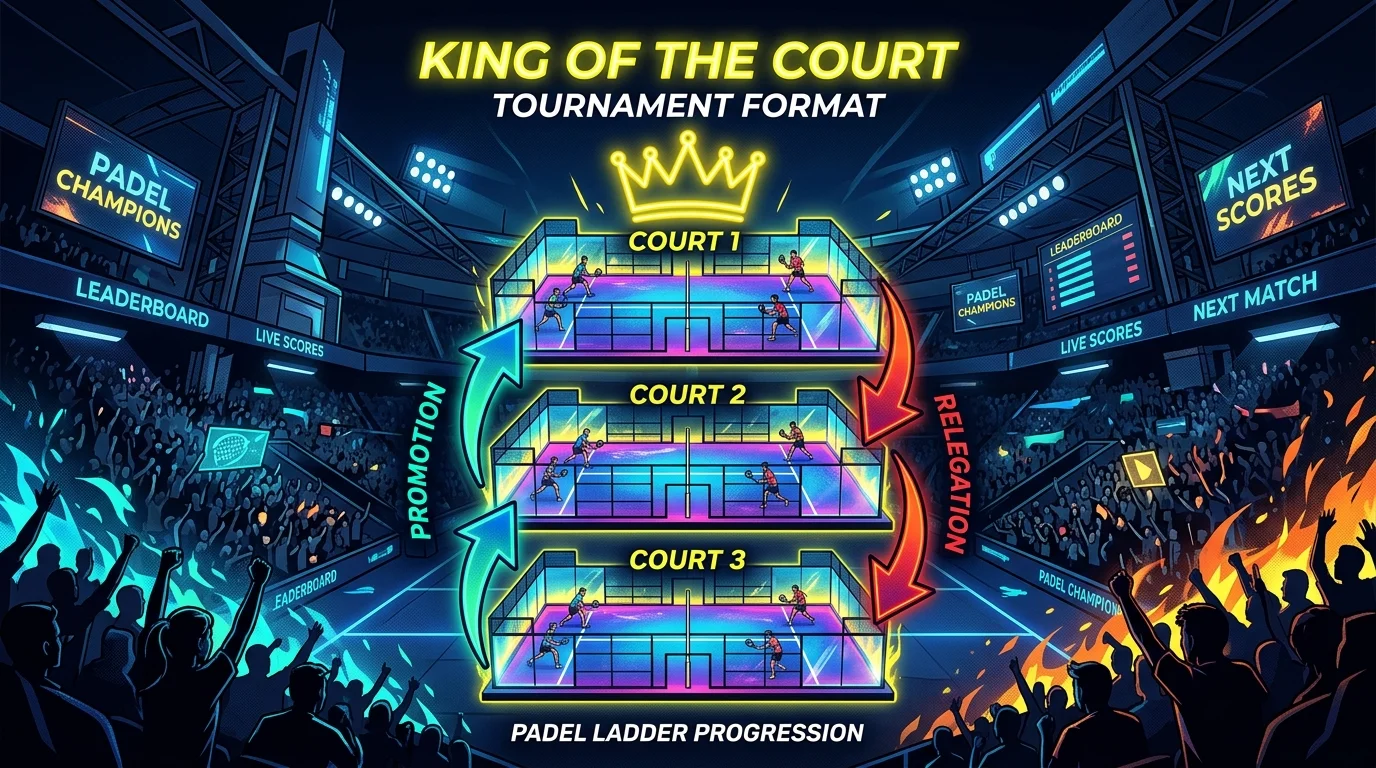
The core concept is simple: courts are ranked in a hierarchy. If you have 3 courts:
- Court 1: The "King's Court" (the top court).
- Court 2: The middle court.
- Court 3: The bottom court.
The goal is to reach and stay on Court 1. Matches are played simultaneously on all courts. At the end of each round, players move up or down depending on their match outcome:
- Winners move up one court (e.g., winners on Court 3 move to Court 2, winners on Court 2 move to Court 1).
- Losers move down one court (e.g., losers on Court 1 move to Court 2, losers on Court 2 move to Court 3).
- Exceptions at the boundaries:
- Winners on Court 1 (King's Court) stay on Court 1.
- Losers on the bottom court stay on the bottom court.
- Draws: In case of a draw, players stay on their current court.
Individual vs. Fixed Partners
King of the Court can be played in two ways:
1. Individual Mode (Default)
Players join as individuals. In each round, they are grouped onto courts of 4 players. After moving up or down at the end of the round, they split and partner with a new player on their new court. The algorithm ensures you avoid playing with the same partner in consecutive rounds.
2. Fixed Partners Mode
Players register as fixed teams of 2. The entire team moves up or down together, playing against other teams. This is excellent for competitive club duos who want to test their teamwork against a climbing ladder of opponents.
The Scoring System: Court Priority Points
One of the most unique elements of the King of the Court format is how points are calculated. In formats like Americano, you get points based on raw match scores. In King of the Court, the points you earn are determined by the court you play on.
Because the goal is to climb to Court 1, playing on higher courts is rewarded with more points. If you play on Court C in a tournament with M courts, the points awarded to you for that match are calculated as:
Points Earned = M - C + 1
For example, in a 3-court tournament:
- Playing on Court 1 gives you 3 points.
- Playing on Court 2 gives you 2 points.
- Playing on Court 3 gives you 1 point.
This court-priority scoring mechanism ensures that the player who successfully reaches and remains on Court 1 (the King's Court) accumulates the highest total points to win the tournament.
King of the Court vs. Americano vs. Mexicano
| Feature | King of the Court | Americano | Mexicano |
|---|---|---|---|
| Pairing Dynamic | Ladder-based (move up/down courts) | Fixed round-robin rotation | Standings-based leaderboard matching |
| Partnering | Rotates on the court (or fixed teams) | Partner with everyone once | Top standing players partner up |
| Scoring basis | Court level priority points | Accumulated match scores (e.g. 21-11) | Accumulated match scores (e.g. 21-11) |
| Competitiveness | High (ladder climbing race) | Balanced / Social | High (skill-matched pairing) |
| Schedule predictability | Dynamic based on win/loss | Fully pre-calculated | Dynamic based on standings |
How to Set Up Your Tournament
- Player count: Requires a minimum of 4 players (1 court). For individual play, any multiple of 4 works best (8, 12, 16, etc.). With odd counts, a sit-out rotation is applied.
- Number of courts: You need 1 court for every 4 active players.
- Round duration: Typically played as timed rounds (e.g., 12 to 15 minutes) or fixed points (e.g., first team to 16 points). Since court changes must happen together, timed rounds are highly recommended to keep matches ending simultaneously.
- Rounds: You can play as many rounds as you like (commonly 6 to 10 rounds).
Running King of the Court with Banana Padel
Managing the ladder movements, resolving court assignment collisions, and tracking court priority points manually can be overwhelming for organizers. Banana Padel handles all of this automatically:
- Choose King of the Court format when creating a tournament.
- Set whether it is played with individual entries or fixed partners.
- Enter scores for each match. The app immediately identifies the winners and losers.
- The system automatically promotes, demotes, or keeps players on their correct courts, resolving any schedule collisions.
- The live scoreboard automatically calculates standings based on court-priority points in real-time, displaying them beautifully on players' phones or casted to a TV screen.
Get started today by creating a tournament for free at banana-padel.com!
Frequently Asked Questions
How does court promotion and relegation work in King of the Court?
Courts are numbered hierarchically where Court 1 is the King Court. After every round, the winning pair on each court moves up one court toward Court 1 (winners on Court 1 stay), while the losing pair drops down one court (losers on the lowest court stay).
How long are match rounds in King of the Court?
Timed rounds of 12 to 15 minutes are most common because all courts must finish at the same time to allow players to switch courts together. Alternatively, rounds can be played to a fixed target (such as 16 or 21 points).
Can King of the Court be played with individual rotation instead of fixed pairs?
Yes. In individual King of the Court, the two winners on a court move up and split to become opponents in the next round, while the two losers move down and also split, ensuring dynamic variety in partner combinations.
What happens if a match ends in a tie?
If a timed round ends in a tie, players remain on their current court for the next round (or play a single sudden-death Golden Point to decide the court movement).
How is the tournament winner determined in King of the Court?
Standings are determined either by the pair/players finishing on Court 1 at the end of the final round, or by weighted points awarded for games won on higher-priority courts across all rounds.

Padel Academy Coach
Former competitive padel player, head of junior padel development
View all guides by Miguel SilvaTry Banana Padel for Free
Create and manage Americano & Mexicano tournaments with automatic rotation, live scoreboards, and Elo ratings. No subscription required.